Q.1.
If $$\sin { \alpha } =12/13\left( 0<\alpha <\pi /2 \right)$$ and
$$\cos { \beta } =-\dfrac { 3 }{ 5 } \left( \pi <\beta <\dfrac { 3 }{ 2 } \pi \right) $$, the value of $$\sin { \left( \alpha +\beta \right) }$$ is
$$\cos { \beta } =-\dfrac { 3 }{ 5 } \left( \pi <\beta <\dfrac { 3 }{ 2 } \pi \right) $$, the value of $$\sin { \left( \alpha +\beta \right) }$$ is
-
0%
$$\dfrac{-56}{65}$$
-
0%
$$\dfrac{16}{65}$$
-
0%
$$\dfrac{56}{65}$$
-
0%
$$\dfrac{-16}{65}$$
Q.2.
The maximum value of the expression $$\dfrac { 1 }{ \sin ^{ 2 }{ \theta } +3\sin { \theta } \cos { \theta } +5\cos ^{ 2 }{ \theta } } $$ is
-
0%
$$2$$
-
0%
$$3$$
-
0%
$$\dfrac { 1 }{ 2 } $$
-
0%
$$\dfrac { 1 }{ 3 } $$
Q.3.
If $$\cos { \left( A-B \right) } =3/5$$ and $$\tan { A } \tan { B } =2$$, then
-
0%
$$\cos { A } \cos { B } =1/5$$
-
0%
$$\sin { A } \sin { B } =-2/5$$
-
0%
$$\cos { \left( A+B \right) } =-1/5$$
-
0%
$$\sin { A } \cos { B } =4/5$$
Q.4.
The number of solutions of the pair of equations.
$$2\sin^2\theta -\cos 2\theta =0$$
$$2\cos^2\theta -3\sin \theta =0$$
in the interval $$[0, 2\pi]$$ is?
$$2\sin^2\theta -\cos 2\theta =0$$
$$2\cos^2\theta -3\sin \theta =0$$
in the interval $$[0, 2\pi]$$ is?
-
0%
Zero
-
0%
One
-
0%
Two
-
0%
Four
Q.5.
State true or false
If sin x = sin$$\lambda$$, then the values of sin(x/3) are sin ($$\lambda$$/3), sin [$$(\pi- \lambda)$$ /3] and - sin [$$(\pi+\lambda)$$ /3]
If sin x = sin$$\lambda$$, then the values of sin(x/3) are sin ($$\lambda$$/3), sin [$$(\pi- \lambda)$$ /3] and - sin [$$(\pi+\lambda)$$ /3]
-
0%
True
-
0%
False
Q.6.
If $$2\sin^2\theta -5\sin \theta +2 > 0, \theta \in (0, 2\pi)$$, then $$\theta \in$$
-
0%
$$\left(\dfrac{5\pi}{6}, 2\pi\right)$$
-
0%
$$\left(0, \dfrac{\pi}{6}\right)\cup \left(\dfrac{5\pi}{6}, 2\pi\right)$$
-
0%
$$\left(0, \dfrac{\pi}{6}\right)$$
-
0%
$$\left(\dfrac{\pi}{80}, \dfrac{\pi}{6}\right)$$
Q.7.
If $$\alpha, \beta, \gamma, \delta$$ are the smallest $$+$$ive angles in ascending order of magnitude which have their sines equal to a $$+$$ive quantity $$\lambda$$ then the value of $$4\sin \dfrac{\alpha}{2}+3\sin \dfrac{\beta}{2}+2\sin \dfrac{\gamma}{2}+\sin \dfrac{\delta}{2}=$$.
-
0%
$$2\sqrt{1-\lambda}$$
-
0%
$$2\sqrt{1+\lambda}$$
-
0%
$$2\sqrt{\lambda}$$
-
0%
$$2\sqrt{\lambda +2}$$
Q.8.
If $$0\leq x\leq \pi$$ and $$81^{\sin^2x}+81^{\cos^2x}=30$$, then x is equal to.
-
0%
$$\pi /6$$
-
0%
$$\pi /3$$
-
0%
$$5\pi /6$$
-
0%
$$2\pi /3$$
-
0%
All correct
Q.9.
Solve: $$2(\cos x+\cos 2x)+\sin 2x(1+2\cos x)=2\sin x, -\pi \leq x \leq \pi$$.
-
0%
$$-\pi, -\pi /2, -\pi /3, \pi/3, \pi$$.
-
0%
$$-\pi, -\pi /2, \pi /3, \pi$$.
-
0%
$$-\pi, -\pi /3, \pi /2, \pi/3, \pi$$.
-
0%
None of these
Q.10.
Solve $$(2+\sqrt{3})\cos\theta =1-\sin \theta$$.
-
0%
$$\theta =-2n\pi -\dfrac{2\pi}{3}$$
-
0%
$$\theta =2r\pi -\dfrac{2\pi}{3}$$.
-
0%
$$\theta =2r\pi +\dfrac{2\pi}{3}$$.
-
0%
$$\theta =n\pi -\dfrac{2\pi}{3}$$
Q.11.
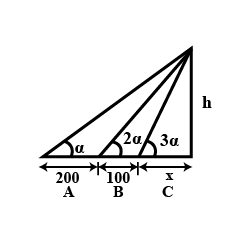
A balloon is observed simultaneously from three points A B and C, on a straight road directly under it. The angular elevation at B is twice of what it is at A and the angular elevation at C is thrice of what it is at A. If the distance between A and B is 200 meters and the distance between B and C is 100 meters, then find the height of the balloon.
-
0%
$$50 \sqrt{3}$$m
-
0%
$$50 $$m
-
0%
$$150 \sqrt{3}$$m
-
0%
$$100 \sqrt{3}$$m
Explanation
Q.12.
Solve $$\tan \theta +\sec \theta =\sqrt{3}; 0\leq \theta \leq 2\pi$$.
-
0%
$$\theta =2n\pi -\dfrac{\pi}{6}$$.
-
0%
$$ \theta =n\pi +\dfrac{\pi}{6}$$.
-
0%
$$ \theta =2n\pi +\dfrac{5\pi}{6}$$.
-
0%
$$ \theta =2n\pi +\dfrac{\pi}{6}$$.
Q.13.
If $$P\left( 4 \right) = 3$$ and $$\displaystyle {\sin ^6}x + {\cos ^6}x = {a \over b}\left( {a,b \in N} \right)$$ and $$a,b$$ are relatively prime, then $$a + b$$ is equal to
-
0%
$$7$$
-
0%
$$23$$
-
0%
$$16$$
-
0%
$$9$$
Q.14.
The equation $${\sin ^6}x + {\cos ^6}x = {a^2}$$ has real solution if
-
0%
$$a \in \left( { - 1,1} \right)$$
-
0%
$$a \in \left( { - 1, - {1 \over 2}} \right)$$
-
0%
$$\eqalign{
& a \in \left( { - {1 \over 2},{1 \over 2}} \right) \cr
& a \in \left( {{1 \over 2},1} \right) \cr} $$ -
0%
$$a \in \left( {{1 \over 2},1} \right)$$
Q.15.
If $$\sec A + \tan A = m $$ and $$ \sec A - \tan A = n$$, find the value of $$\sqrt{mn}$$.
-
0%
$$0$$
-
0%
$$\pm 1$$
-
0%
$$\pm 2$$
-
0%
$$\pm 3$$
Q.16.
If $$8\sin(p+2q)= 5\sin p$$ , then $$3(\tan p+\tan q)= \dfrac{2\tan p}{\cos^2q}$$.
-
0%
True
-
0%
False
Q.17.
The most general value of $$\theta $$ satisfying both the equations $$\sin \theta = \frac{1}{2},\tan \theta = \frac{1}{{\sqrt 3 }}\;is\;\left( {n \in I} \right)$$
-
0%
$$2n\pi + \frac{\pi }{6}$$
-
0%
$$\left( b \right)2n\pi - \frac{{7\pi }}{6}$$
-
0%
$$\left( c \right)2n\pi + \frac{{5\pi }}{6}$$
-
0%
None of these
Q.18.
The expression $$\dfrac{{\tan A + \sec A - 1}}{{\tan A - \sec A + 1}}$$ reduces to :
-
0%
$$\dfrac {1+\sin A}{\cos A}$$
-
0%
$$\dfrac {1-\sin A}{\cos A}$$
-
0%
$$\dfrac {1+\cos A}{\sin A}$$
-
0%
$$\dfrac {1+\cos A}{\cos A}$$
Q.19.
If $$\sin^2 \theta +\cos^2\theta =1$$ then
$$\sin^{12}\theta +3 \sin^{10}\theta +3 \sin^8\theta +\sin^6\theta +2\sin^4\theta +2\sin^2\theta -4=1$$
$$\sin^{12}\theta +3 \sin^{10}\theta +3 \sin^8\theta +\sin^6\theta +2\sin^4\theta +2\sin^2\theta -4=1$$
-
0%
True
-
0%
False
Q.20.
If $$\sin \left( {\pi \cos x} \right) = \cos \left( {\pi \sin x} \right)$$, then $$\sin 2x = $$
-
0%
$$ -\dfrac{3}{4}$$
-
0%
$$ -\dfrac{4}{3}$$
-
0%
$$ \dfrac{1}{3}$$
-
0%
none of these
Q.21.
The function $$f(x)=a \sin x+\dfrac {1}{3}\sin 3x$$ has a maximum at $$x=\pi/3$$, then a equals-
-
0%
$$-2$$
-
0%
$$2$$
-
0%
$$-1$$
-
0%
$$1$$
Q.22.
If $$\alpha cos^23\theta +\beta cos^4\theta= 16 cos^6\theta + 9 cos^2\theta$$ is an identity then-
-
0%
$$\alpha = 1, \beta = 18$$
-
0%
$$\alpha = 1, \beta = 24$$
-
0%
$$\alpha = 3, \beta = 24$$
-
0%
$$\alpha = 4, \beta = 2$$
Q.23.
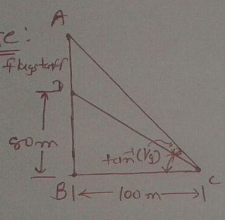
A flag staff on the top of the tower $$80\ meter$$ high, subtends an angle $$\tan^{-1}\left(\dfrac{1}{9}\right)$$ at point on the ground $$100\ meters$$ away from the foot of the tower. Find the height of the flag-staff.
-
0%
$$20\ m$$
-
0%
$$30\ m$$
-
0%
$$25\ m$$
-
0%
$$35\ m$$
Explanation
Q.24.
If $$x=\dfrac{{2\left( {\sin {1^0} + \sin {2^0} + \sin {3^0} + ....... + \sin {{89}^0}} \right)}}{{2\left( {\cos {1^0} + \cos {2^0} + .............\cos {{44}^0}} \right) + 1}}$$ , then the value of $${\log_x}2$$ is equal
-
0%
$$0$$
-
0%
$$\dfrac { 1 }{ 2 } $$
-
0%
$$1$$
-
0%
$$2$$
Q.25.
If $$A + B + C = \pi $$, then $${\sin ^4}A + {\sin ^4}B + {\sin ^4}C = \cfrac{3}{2} + 2\cos A\cos B\cos C + \cfrac{1}{2}\cos 2A\cos 2B\cos 2C$$
-
0%
True
-
0%
False
Q.26.
If $$x \in (\pi, 2\pi)$$ and $$\cos x + \sin x = \dfrac{1}{2}$$, then the value of $$\tan x$$ is
-
0%
$$\dfrac{4 - \sqrt{7}}{3}$$
-
0%
$$\dfrac{\sqrt{7} - 4}{3}$$
-
0%
$$\dfrac{-4 + \sqrt{7}}{3}$$
-
0%
$$-\left(\dfrac{4 + \sqrt{7}}{3}\right)$$
Q.27.
If $$\dfrac{{\left( {1 - \cos A} \right)}}{2} = x$$ then find the value of x is
-
0%
$${\cos ^2}\left( {\dfrac{A}{2}} \right)$$
-
0%
$$\sqrt {\sin \left( {\dfrac{A}{2}} \right)} $$
-
0%
$$\sqrt {\cos \left( {\dfrac{A}{2}} \right)} $$
-
0%
$${\sin ^2}\left( {\dfrac{A}{2}} \right)$$
Q.28.
If $$\sin \theta = n \sin(\theta + 2 \alpha) $$ then $$\tan (\theta + \alpha)$$ =
-
0%
$$\dfrac{1 + n}{1 - n} \tan \, \alpha$$
-
0%
$$\dfrac{1 - n}{1 + n} \tan \, \alpha$$
-
0%
$$\tan \, \alpha$$
-
0%
None
Q.29.
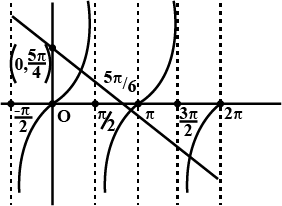
Total number of solution of the equation $$3x+2\tan x=\dfrac {5\pi}{2}$$ in $$x\ \epsilon [0,2\pi]$$ is equal to
-
0%
$$1$$
-
0%
$$2$$
-
0%
$$3$$
-
0%
$$4$$
Explanation
Q.30.
$$\sin^{-1}x+\sin^{-1}\dfrac{1}{x}+\cos^{-1}x+\cos^{-1}\dfrac{1}{x}, x\notin \pm 1$$ is equal to?
-
0%
$$\pi$$
-
0%
$$\dfrac{\pi}{2}$$
-
0%
$$\dfrac{3\pi}{2}$$
-
0%
None of these