Q.1.
Area (in sq units) enclosed by y = 1, 2x + y = 2 and x + y = 2
-
0%
1/2
-
0%
1/4
-
0%
1
-
0%
2
-
0%
4

Q.2.
If algebraic sum of distances of a variable line from points (2, 0), (0,and (-2, -is zero, then the line passes through the fixed point
-
0%
(- 1, - 1)
-
0%
(1, 1)
-
0%
(2, 2)
-
0%
(0, 0)
Q.3.
If C is the reflection of A(2,in X - axis and B is the reflection of C is Y - axis, then |AB| is equal to
-
0%
20
-
0%
2√5
-
0%
4√5
-
0%
4
Q.4.
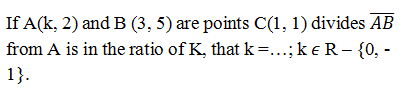
-
0%
- 4
-
0%
- 2
-
0%
4
-
0%
2
Q.5.
Point Q is symmetric to P(4, -with respect to the bisector of the first quadrant. The length of PQ is
-
0%
3√2
-
0%
5√2
-
0%
7√2
-
0%
9√2
Q.6.
One possible condition for the three points (a, b), (b, a) and (a2, - b2) to be collinear, is
-
0%
a - b = 2
-
0%
a + b = 2
-
0%
a = 1 + b
-
0%
a = 1 - b
Q.7.
If points (5,, (10,k) and (-5,are collinear , then k =
-
0%
3
-
0%
5
-
0%
7
-
0%
9
Q.8.
The mid point of the line joining the points (-10,and (-6,divides the line joining the points (4, -and (-2,in the ratio
-
0%
1 : 2 internally
-
0%
1 : 2 externally
-
0%
2 : 1 internally
-
0%
2 : 1 externally
-
0%
2 : 3 externally
Q.9.
The image of the center of the circles x2 + y2 = a2 with respect to the mirror image x + y = 1 is
-
0%
(1/√2, √2)
-
0%
(√2, √2)
-
0%
(√2, 2√2)
-
0%
None of these
Q.10.
If P(1, 2), Q (4, 6), R(5,and S (a, b) are the vertices of a parallelogram PQRS, then
-
0%
a = 2, b = 4
-
0%
a = 6, b = 4
-
0%
a = 2, b = 3
-
0%
a = 3, b = 5
Q.11.
The point P is equidistant from A (1, 3), B (-3,and C (5, - 1), then PA is equal to
-
0%
5
-
0%
5√5
-
0%
25
-
0%
5√10
Q.12.
The mid - points of the sides of a triangle are D (6, 1), E (3,and F(-1, - 2), then the vertex opposite to D is
-
0%
(-4, 2)
-
0%
(-4, 5)
-
0%
(2, 5)
-
0%
(10, 8)
Q.13.
(0, -and (0,are two opposite vertices of a square. The other two vertices are
-
0%
(0, 1), (0, - 3)
-
0%
(3, - 1), (0, 0)
-
0%
(2, 1), (-2, 1)
-
0%
(2, 2), (1 , 1)
Q.14.
Points (1/2, - (13/4)) divides the line joining the points (3, -and (-7,in the ratio of
-
0%
1 : 3 internally
-
0%
3 : 1 internally
-
0%
1 : 3 externally
-
0%
3 : 1 externally
-
0%
None of these
Q.15.
The ratio in which the line x + y = 4 divides the line joining the points (1, -and (5,is
-
0%
1 : 2
-
0%
2 : 1
-
0%
1 : 3
-
0%
3 : 1
-
0%
3 : 2
Q.16.
The circumcentre of the triangle with vertices (8, 6), (8, -and (2, -is at the point
-
0%
(2, - 1)
-
0%
(1, - 2)
-
0%
(5, 2)
-
0%
(2, 5)
-
0%
(4, 5)
Q.17.
ABC is a triangle with vertices A(-1,, B(6, -and C (-2, 4), D, E and F are the points which divide each AB, BC and CA, respectively in the ratio 3 : 1 internally. Then, the centroid of the ∆DEF is
-
0%
(4, 8)
-
0%
(3, 6)
-
0%
(1, 2)
-
0%
( - 3, 6)
-
0%
None of the above
Q.18.
The vertices of a triangle are A (0, 0), B (0,and C (2, 0), then find the distance between its orthocentre and circumcentre
-
0%
0
-
0%
√2
-
0%
1/√2
-
0%
None of these
Q.19.
Orthocentre of the triangle formed by the lines x - y = 0, x + y = 0, x = 3, is
-
0%
(0, 0)
-
0%
(3, 0)
-
0%
(0, 3)
-
0%
Cannot be determined
Q.20.
Three distinct points A, B and C' given in the two-dimensional coordinate plane such that the ratio of the distance of any one of them from the point (1,to the distance from the point (-1,is equal to 1/ 3. Then, the circumcentre of the .ABC is at the point
-
0%
(5/4, 0)
-
0%
(5/2, 0)
-
0%
(5/3, 0)
-
0%
(0, 0)
Q.21.
The vertices of a triangle are (6, 0), (0,and (6, 6). The distance between its circumcentre and centroid is
-
0%
2
-
0%
√2
-
0%
1
-
0%
2√2
Q.22.
The coordinates of the incentre of the triangle having sides 3x - 4y = 0, 5x + 12y = 0 and y - 15 = 0 are
-
0%
(-1, 8)
-
0%
(1, - 8)
-
0%
(2, 6)
-
0%
None of these
Q.23.
The orthocentre of the triangle with vertices O (0, 0), A (0, 3/2), B (-5,is
-
0%
(5/2, 3/4)
-
0%
(-5/2, 3/4)
-
0%
(-5, 3/2)
-
0%
(0, 0)
Q.24.
The centroid if the ∆ABC, where A = (2,, B = (8,and C = (5,is
-
0%
(5, 6)
-
0%
(6, 5)
-
0%
(6, 6)
-
0%
(15, 18)
Q.25.
The circumcentre of the triangle with vertices (0, 30), (4,and (30,is
-
0%
(10, 10)
-
0%
(10, 12)
-
0%
(12, 12)
-
0%
(15, 15)
-
0%
(17, 17)
Q.26.
The coordinates of the orthocentre of the triangle formed by (0,, (8,and (4,is
-
0%
(4, 0)
-
0%
(6, 3)
-
0%
(6, 0)
-
0%
None of these
Q.27.
The vertices P, Q and R of a triangle are (2,, (5,and (3, 4), respectively. Then, the circumcentre is
-
0%
(13/4, 9/4)
-
0%
(- (13/4), 9/4)
-
0%
(-(13/4), -(9/4))
-
0%
(13/4, 9/4)
Q.28.
In ∆ABC ,G is the centroid, D is the mid-point of BC. If
A = ( 2,3 ) and G = ( 7,5 ), then the point D is
-
0%
(9/2, 4)
-
0%
(19/2, 6)
-
0%
(11/2, 11/2)
-
0%
(8, 13/2)
Q.29.
Let ABC be a triangle, two of whose vertices are (15,and (0, 10). If the orthocentre is (6, 9), then the third vertex is
-
0%
(15, 10)
-
0%
(10, -15)
-
0%
(0, 0)
-
0%
None of these
Q.30.
If orthocentre and circumeentre of a triangle are respectively (1,) and (3. 2), then the coordinates of its centroid are
-
0%
(7/3, 5/3)
-
0%
(5/3, 7/3)
-
0%
(7, 5)
-
0%
None of these