Q.1.
The linear parent function, f(x) = x, is transformed to g(x) = f(x) -Describe the transformation.
-
0%
g(x) is shifted up 6 units
-
0%
g(x) is shifted down 6 units
-
0%
g(x) is shifted left 6 units
-
100%
g(x) is shifted right 6 units
Q.2.
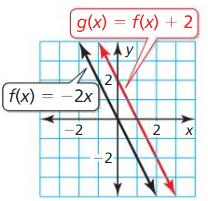
Use the graphs of f and g to describe the transformation from the graph of f to the graph of g.
-
0%
The graph of g is a vertical translation 2 units up of the graph of f
-
100%
The graph of f is a horizontal translation two units left of g
-
0%
The graph of g is a vertical stretch by a factor of 2 of the graph of f
-
0%
The graph of g is a reflection of the graph of f
Q.3.
Which transformation will occur if f(x) = x is replaced with 2f(x)?
-
0%
Vertical stretch by a factor of 2
-
0%
Vertical compression by a factor of 1/2
-
100%
Vertical translation up by 2 units.
-
0%
Horizontal compression by a factor of 1/2
Q.4.
A student graphed f(x) = x and g(x) = ⅓f(x). Which statement is true?
-
0%
The graph of f is steeper than the graph of g.
-
0%
The graph of f is less steep than the graph of g.
-
0%
The graph of f is shifted 2 units up to create the graph of g.
-
0%
The graph of f is shifted 2 units to the right to create the graph of g.
Q.5.
Which transformation will occur if f(x) = x is replaced with 14f(x)\frac{1}{4}f\left(x\right)41f(x) ?
-
0%
Vertical stretch by a factor of 4
-
0%
Vertical compression by a factor of 1/4
-
0%
Vertical translation up by 1/4 units.
-
0%
Horizontal compression by a factor of 1/4
Q.6.
What is the linear parent function?
-
0%
y = x
-
0%
y = mx + b
-
0%
f(x) = 2x
-
0%
Not here
Q.7.
If the graph of the parent function f(x) = x is shifted 7 unitsdown, which of the following equations would the new graphedline represent?
-
0%
f(x) = 7x
-
0%
f(x) = x - 7
-
0%
f(x) = x + 7
-
0%
f(x) = 7x - 7
Q.8.
Describe the transformation from the parent function: y = 3x + 5
-
0%
Steeper; Shift up 5 units
-
0%
Steeper; Shift down 5 units
-
0%
Flatter; Shift up 5 units
-
0%
Flatter; Shift down 5 units
Q.9.
Which of the following g(x) equations is vertically stretched and shifted down from f(x) = x?
-
0%
g(x) = 2 f(x) + 6
-
0%
g(x) = 1/2 f(x) + 6
-
0%
g(x) = 2 f(x) - 6
-
0%
g(x) = 1/2 f(x) - 6
Q.10.
The linear parent function, f(x) = x, is transformed to g(x) = f(x) +Describe the transformation.
-
0%
g(x) is shifted up 3 units
-
0%
g(x) is shifted down 3 units
-
0%
g(x) is shifted left 3 units
-
0%
g(x) is shifted right 3 units
Q.11.
Which transformation on f(x) = x is g(x) = -f(x)
-
0%
Reflection across the y-axis
-
0%
The slope will be less steep
-
0%
The graph will be wider
-
0%
Reflection across the x-axis.
Q.12.
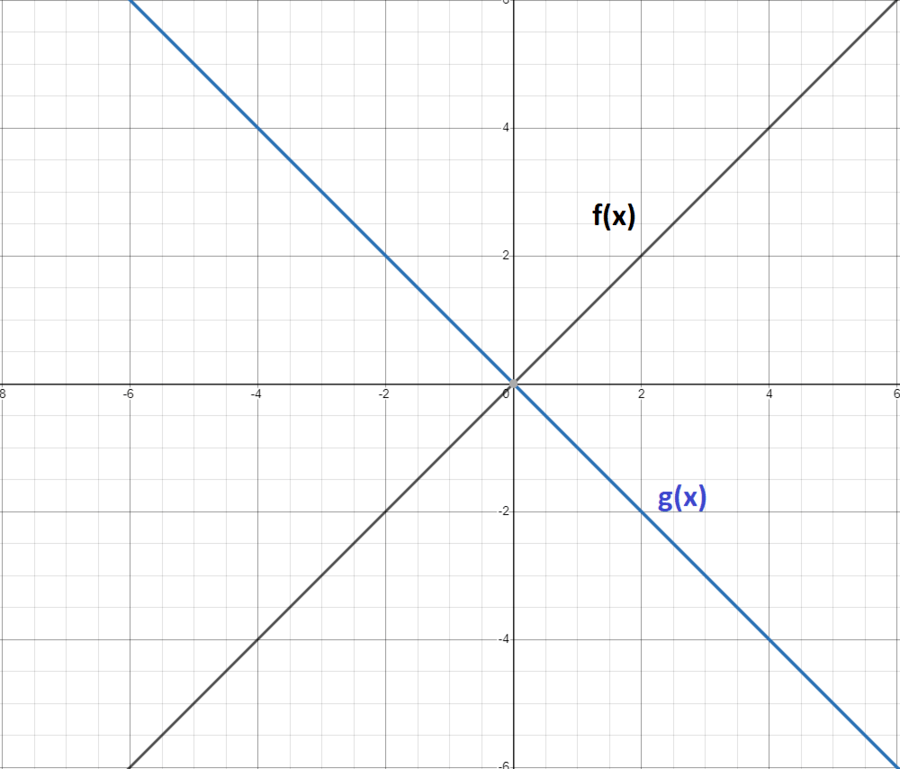
Use the graphs of f and g to describe the transformation from the graph of f to the graph of g.
-
0%
Graph g is a reflection.
-
0%
Graph g shifts down 2 units.
-
0%
Graph g is steeper by a factor of 2
-
0%
Graph g is less steeper by a factor of 1/2
Q.13.
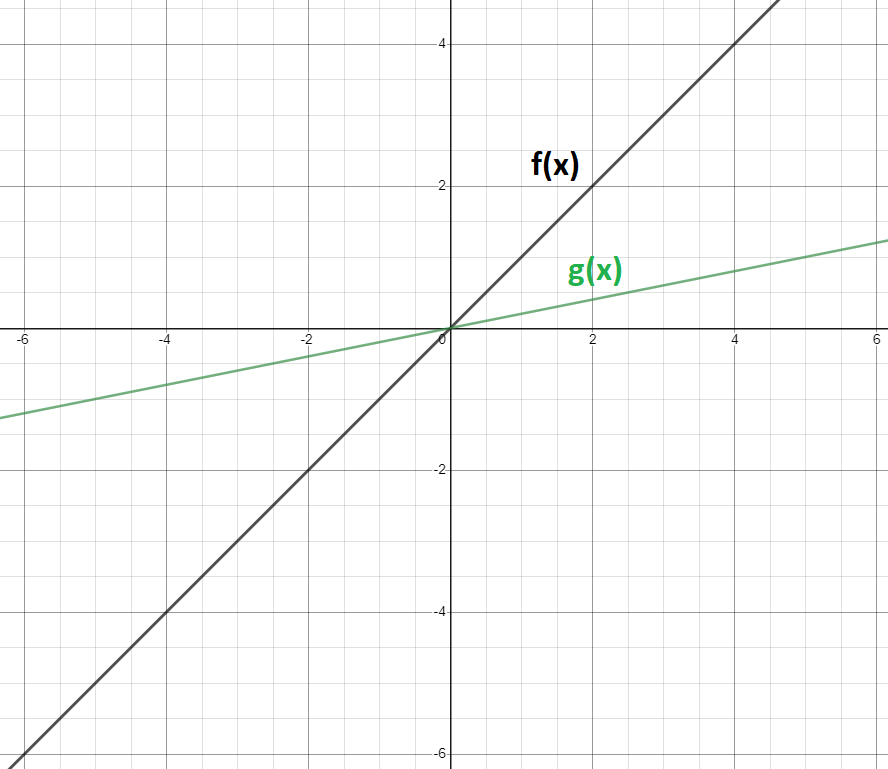
Use the graphs of f and g to describe the transformation from the graph of f to the graph of g.
-
0%
Graph g is less steep by a factor of 1/5
-
0%
Graph g shifted down 1 unit
-
0%
Graph g is steeper by a factor of 1/5
-
0%
Graph g shifted up 2 units
Q.14.
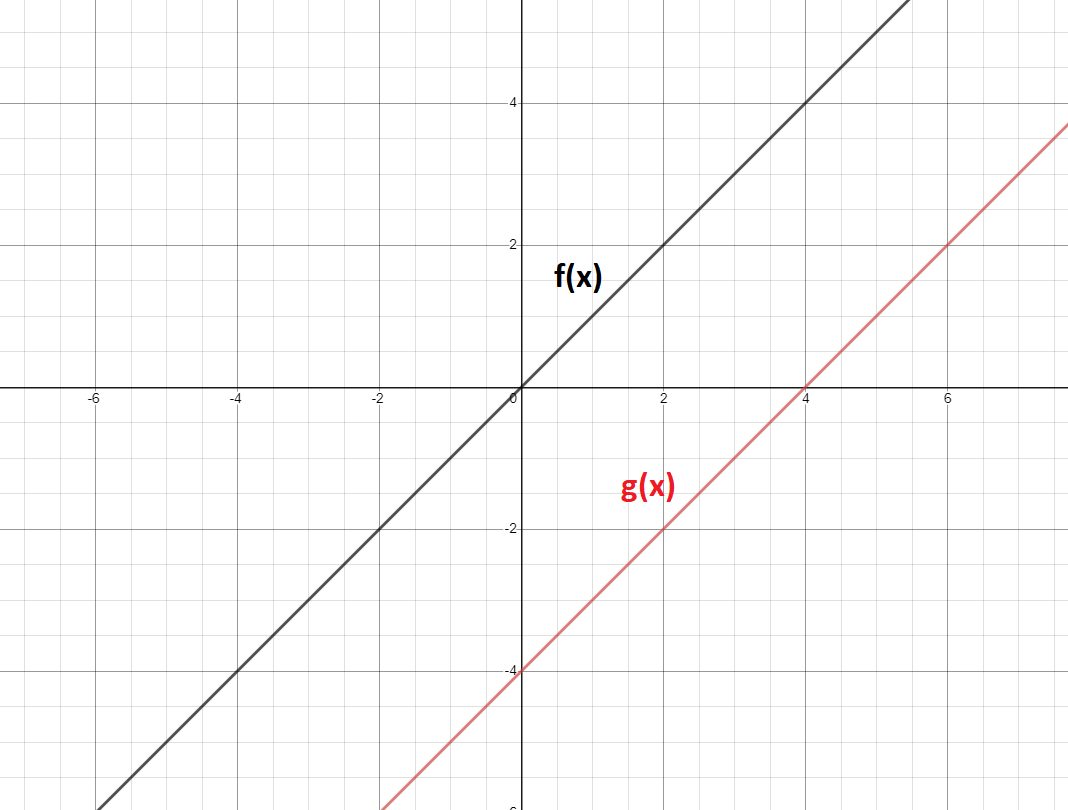
Use the graphs of f and g to describe the transformation from the graph of f to the graph of g.
-
0%
Graph g shifted down 3 units
-
0%
Graph g shifted down 4 units
-
0%
Graph g shifted up 4 units
-
0%
Graph g reflected
Q.15.
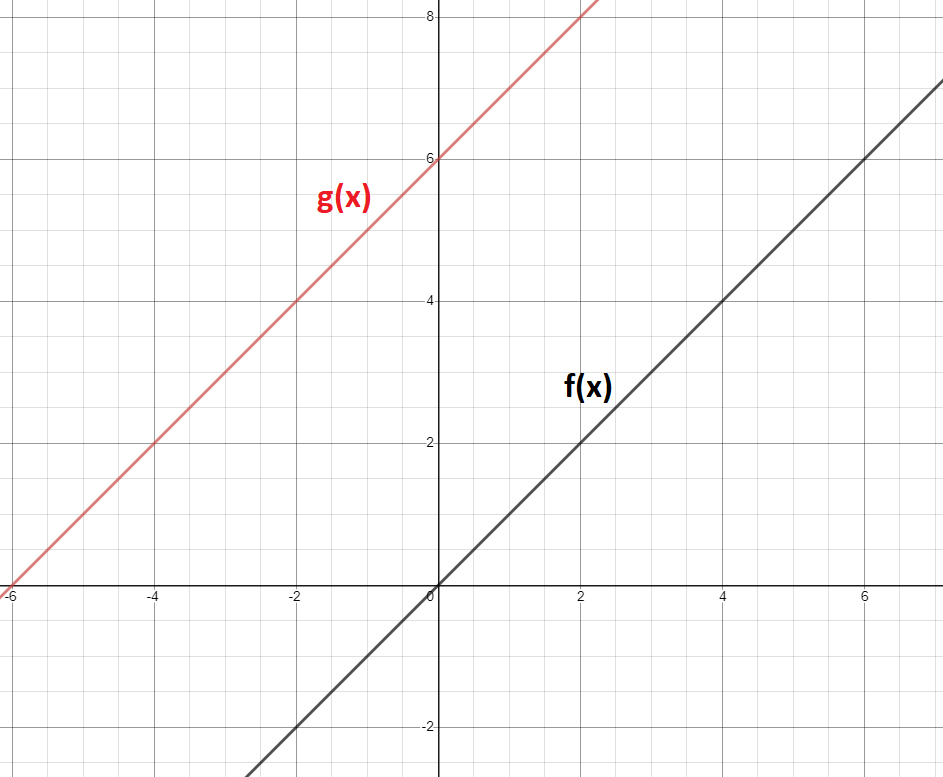
Use the graphs of f and g to describe the transformation from the graph of f to the graph of g.
-
0%
Graph g shifted down 6 units
-
0%
Graph g is steeper by a factor of 7
-
0%
Graph g is less steep by a factor of 1/3
-
0%
Graph g shifted up 6 units
Q.16.
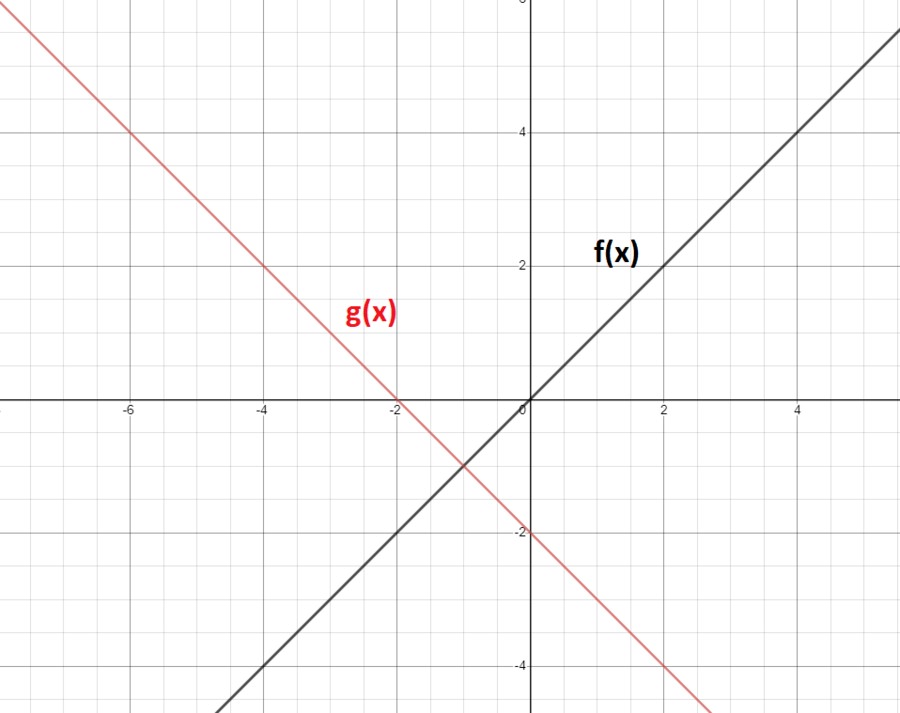
Use the graphs of f and g to describe the transformation from the graph of f to the graph of g.
-
0%
Graph g reflected
-
0%
Graph g shifted up 2 units
-
0%
Graph g reflected and shifted down 2 units.
-
0%
Graph g reflected and shifted up 2 units