Q.1.
A force of 30 N stretches a very light ideal spring 0.73 m from equilibrium. What is the force constant (spring constant) of the spring?
-
50%
41 N/m
-
27%
22 N/m
-
15%
34 N/m
-
8%
46 N/m
Q.2.
A pair of trapeze performers at the circus is swinging from ropes attached to a large elevated platform. Suppose that the performers can be treated as a simple pendulum with a length of 16 m. Determine the period for one complete back and forth cycle.
-
15%
2 sec
-
21%
12 sec
-
59%
8 sec
-
5%
10 sec
Q.3.
A pendulum is 0.75 meters long and has a period of 4.17 seconds. The Pendulum is on an unknown planet. What is the gravity of the Unknown Planet?
-
18%
9.8
-
19%
3.4
-
43%
1.7
-
21%
Greater than 9.8
Q.4.
If the length of a simple pendulum is doubled, its period will:
-
10%
halve
-
53%
increase by a factor of sqrt(2)
-
20%
decrease by a factor of sqrt(2)
-
17%
double
Q.5.
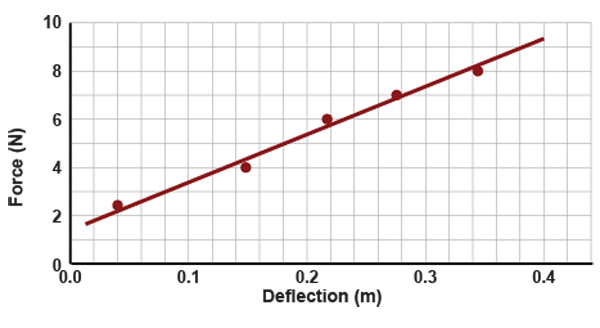
From the graph ,the spring constant is.
-
20%
4.5 m
-
18%
15 N
-
50%
20 N/m
-
12%
200 N/m
Q.6.
What is the equation for frequency?
-
11%
f = t/n
-
82%
f = 1/T
-
7%
f = 2 T
Q.7.
A mass-spring system can oscillate with simple harmonic motion because a compressed or stretched spring has which kind of energy?
-
23%
kinetic
-
16%
mechanical
-
19%
gravitational potential
-
42%
elastic potential
Q.8.
For a system in simple harmonic motion, which of the following is the number of cycles or vibrations per unit of time?
-
7%
amplitude
-
17%
period
-
68%
frequency
-
7%
revolution
Q.9.
What is the period on Earth of a pendulum with a length of 2.4 m?
-
38%
3.1 sec
-
24%
1.9 sec
-
19%
9.3 sec
-
19%
5.1 sec
Q.10.
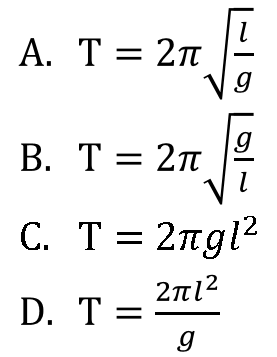
Based on your findings, which equation could best describe the pendulum’s period?
-
74%
A
-
13%
B
-
11%
C
-
3%
D
Q.11.
A simple harmonic oscillator takes 4.8 s to undergo five complete vibrations. What is the frequency of 1cycle?
-
43%
1.04 s
-
23%
4.8 s
-
34%
1/4.8 s
Q.12.
A simple harmonic oscillator takes 4.8 s to undergo five complete vibrations. What is the period (T) of 1 cycle?
-
37%
4.8 s
-
50%
.96 s
-
13%
9.8 s
Q.13.
What is the frequency of a pendulum that has a period of 10 s?
-
9%
10 Hz
-
30%
1/1000 Hz
-
61%
.1 Hz
Q.14.
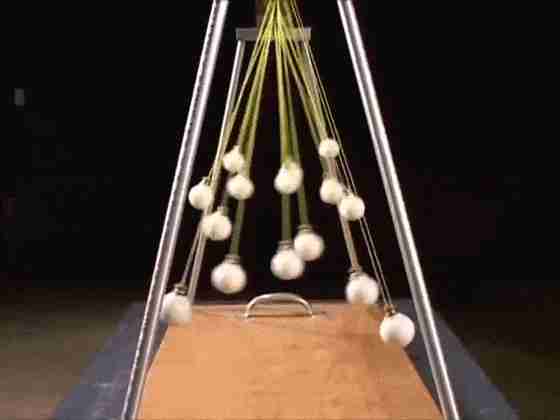
The period of a pendulum may be decreased by
-
35%
Increasing the mass of the bob
-
12%
moving the equilibrium point
-
10%
decreasing the mass of the bob
-
42%
shortening the length of pendulum
Q.15.
The velocity of a spring-block system vibrating along the y-axis changes with time according to the equation: 𝑣(𝑡) = 2𝜋 cos(𝜋𝑡 + 𝜋). All quantities in the equation are expressed in S.I units. Consider that the object is initially at the equilibrium position. What is the amplitude of the motion of the object in meter?
-
4%
2/𝜋
-
36%
2
-
54%
2𝜋
-
7%
𝜋/2
Q.16.
A block of mass 2.0 kg is attached to a spring. What is the spring constant if the block’s acceleration is 13 m/s2 when it is 0.75 m away from the equilibrium position ?
-
48%
35 N/m
-
29%
22 N/m
-
16%
12 N/m
-
6%
8 N/m
Q.17.
The velocity of a spring-block system vibrating along the y-axis changes with time according to the equation: 𝑣(𝑡) = 2𝜋 cos(𝜋𝑡 + 𝜋). All quantities in the equation are expressed in S.I units. Consider that the object is initially at the equilibrium position. What is the maximum acceleration of the object?
-
11%
𝜋
-
46%
2𝜋
-
39%
2𝜋2
-
4%
𝜋/2
Q.18.
The velocity of a spring-block system vibrating along the y-axis changes with time according to the equation: 𝑣(𝑡) = 2𝜋 cos(𝜋𝑡 + 𝜋). All quantities in the equation are expressed in S.I units. Consider that the object is initially at the equilibrium position. What is the value of the velocity (in m/s) at the instant when the acceleration is zero?
-
54%
2𝜋
-
29%
2𝜋2
-
12%
𝜋
-
4%
𝜋/2
Q.19.
The maximum velocity occurs where the ____.
-
15%
potential energy is a maximum
-
23%
kinetic energy is a minimum
-
31%
displacement from equilibrium is equal tothe amplitude of 0.4 𝑚
-
31%
displacement from equilibrium is equal tozero
Q.20.
An object of mass 𝑚 is attached to a horizontal spring, stretched to a displacement 𝐴 from equilibrium and released, undergoing harmonic oscillations on a frictionless surface with period 𝑇 . The experiment is then repeated with a mass of 4𝑚. What’s the new period of oscillation?
-
29%
2T
-
33%
T
-
25%
4T
-
12%
T√2
Q.21.
When is a pendulum in simple harmonic motion?
-
0%
Never
-
23%
All the time
-
27%
only at large angles
-
50%
only at small angles
Q.22.
When is the pendulum at maximum velocity
-
41%
At its lowest point
-
23%
At its highest point
-
23%
It moves at a constant velocity
-
14%
It is at rest
Q.23.
What is the definition of SHM?
-
57%
periodic motion without loss of energy in which the acceleration of a body is directly proportional to its displacement and is directed towards the equilibrium position but in opposite direction of the displacement.
-
19%
periodic motion without loss of energy in which the acceleration is directly proportional to its velocity and is directed towards the equilibrium position but in opposite direction of the velocity.
-
10%
periodic motion without loss of energy in which the acceleration of a body is inversely proportional to its displacement
-
14%
periodic motion without loss of energy in which the angular frequency is directly proportional to its displacement and is directed towards the equilibrium position but in opposite direction of the displacement.
Q.24.
Position at which the body would come to rest if it were to lose all of its energy refers to
-
50%
equilibrium position
-
27%
maximum displacement / amplitude
-
14%
periodic position
-
9%
good position
Q.25.
The number of cycles or oscillation made in one second is defined as
-
5%
time taken
-
36%
period
-
55%
frequency
-
5%
amplitude
Q.26.
Given an expression of x = 10 sin (0.25πt) where x in cm, t in second. Which of these answers are true?
-
48%
the frequency is 0.125 Hz
-
17%
the amplitude is 10 m
-
17%
the angular frequency is 0.125 rad s-1
-
17%
at t = 0, x = 10 cm
Q.27.
Given an expression of a SHM x = 10 sin (11.4t). Calculate the time taken when x=10 cm for the 1st time
-
30%
0.138 s
-
25%
1.24 s
-
25%
11.11 s
-
20%
0.79 s
Q.28.
For a system in simple harmonic motion, which of the following is the time required to complete a cycle of motion?
-
15%
amplitude
-
40%
period
-
45%
frequency
-
0%
revolution
Q.29.
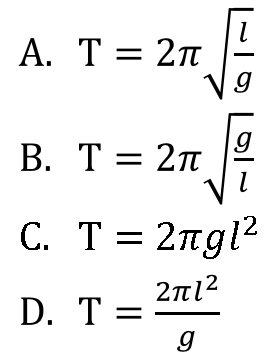
Based on your findings, which equation could best describe the pendulum’s period?
-
63%
A
-
26%
B
-
11%
C
-
0%
D
Q.30.
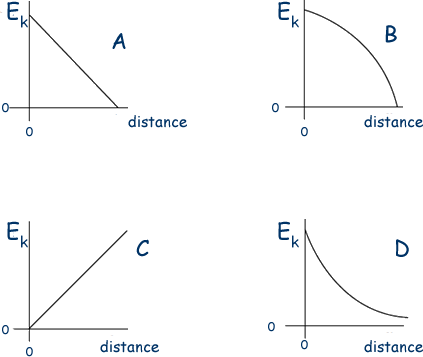
A body executes simple harmonic motion. Which one of the graphs, A to D, best shows the relationship between the kinetic energy, Ek, of the body and its distance from the centre of oscillation?
-
21%
A
-
26%
B
-
21%
C
-
32%
D
Q.31.
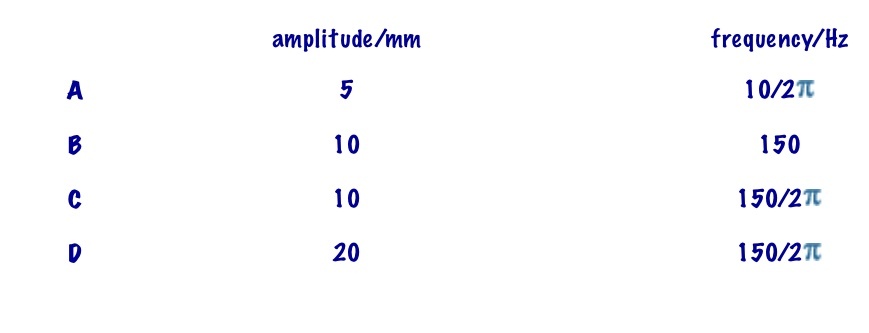
The displacement (in mm) of the vibrating cone of a large loudspeaker can be represented by the equation x = 10 cos (150t), where t is the time in s. Which line, A to D, in the table gives the amplitude and frequency of the vibrations.
-
12%
A
-
44%
B
-
44%
C
-
0%
D
Q.32.
A mechanical system is oscillating at resonance with a constant amplitude. Which one of the following statements is not correct?
-
14%
The applied force prevents the amplitude from becoming too large.
-
29%
The frequency of the applied force is the same as the natural frequency of oscillation of the system.
-
43%
The total energy of the system is constant.
-
14%
The amplitude of oscillations depends on the amount of damping.
Q.33.
A particle of mass 0.20 kg moves with simple harmonic motion of amplitude 2.0 × 10⁻²m. If the total energy of the particle is 4.0 × 10⁻⁵J, what is the time period of the motion?
-
25%
0.79 s
-
19%
1.57 s
-
25%
3.14 s
-
31%
6.28 s
Q.34.
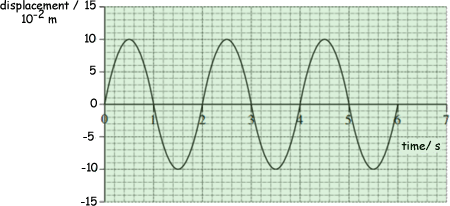
The graph shows the variation in displacement with time for an object moving with simple harmonic motion. What is the maximum acceleration of the object?
-
20%
0.025 m s–2
-
40%
0.99 m s–2
-
20%
2.5 m s–2
-
20%
9.8 m s–2
Q.35.
Two pendulums, P and Q, are set up alongside each other. The period of P is 1.90 s and the period of Q is 1.95 s. How many oscillations are made by pendulum Q between two consecutive instants when P and Q move in phase with each other?
-
31%
19
-
56%
38
-
12%
39
-
0%
78
Q.36.
A particle of mass m oscillates in a straight line with simple harmonic motion of constant amplitude. The total energy of the particle is E. What is the total energy of another particle of mass 2m, oscillating with simple harmonic motion of the same amplitude but double the frequency?
-
33%
2E
-
42%
4E
-
8%
6E
-
17%
8E
Q.37.
The bob of the pendulum moves faster at the lowest position for a larger amplitude.
-
58%
TRUE
-
42%
FALSE
Q.38.
A body executes simple harmonic motion. The potential energy, the kinetic energy and total energy are measured as a function of displacement x. Which of the following statements is true?
-
58%
Kinetic energy is maximum when x = 0
-
17%
Total energy is zero, when x = 0
-
17%
Kinetic energy is maximum when x is maximum
-
8%
Potential energy is maximum when x = 0
Q.39.
If a spring of mass 30kg has a spring constant of 15N/m, then its time period is
-
9%
6.3 s
-
73%
8.9 s
-
9%
5.0 s
-
9%
2.8 s
Q.40.
Simple harmonic motion is defined as the motion of a particle such that
-
31%
its displacement x from the equilibrium position is always given by the expression x = Asinωt
-
8%
its displacement x from the equilibrium position is related to its velocity by the expression v=ωx
-
62%
its acceleration is proportional to, and in the opposite direction to, the displacement from the equilibrium position.
-
0%
Its acceleration is always ω2A and is directed at right angles to its motion
Q.41.
A mass M suspended from a string L undergoes SHM. Which of the following is true about the period of oscillations?
-
20%
The period increases with increasing amplitude
-
20%
The period increases with increasing mass
-
27%
The period increases with decreasing length
-
33%
The period increases with increasing length
Q.42.
A simple pendulum with a length of 1 m oscillates on the surface of a hypothetical planet X. What is thesurface gravity on the planet if the period of oscillations is 4 s?
-
21%
1.6 ms-2
-
29%
3.7 ms-2
-
50%
2.5 ms-2
-
0%
11.2 ms-2