Q.1.
The saliva secreted by salivary glands not
-
67%
Contain electrolytes like $$Na^+,K^+, CI^-$$ and $$3 HCO_3^+$$
-
0%
Give safely against dental carries
-
0%
Bring about hydrolysis of starch upto $$90\%$$
-
33%
Initiate the process of digestion
Q.2.
Plants, but not animals , can convert fatty acids to sugars by a series of reactions called
-
67%
photosynthesis
-
0%
Krebs cycle
-
33%
glycolysis
-
0%
glyoxylate cycle
Q.3.
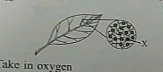
The part labelled as X in the given figure helps the plant to
(i) Take in oxygen
(ii) Take in carbon dioxide
(iii) Give out oxygen
(iv) Give out water vapour
(i) Take in oxygen
(ii) Take in carbon dioxide
(iii) Give out oxygen
(iv) Give out water vapour
-
0%
(i) and (ii) only
-
100%
(ii) anf (iii) only
-
0%
(i), (ii) and (iv) only
-
0%
(i), (ii), (iii) and (iv)
Q.4.
Which statement is correct for blood pressure
-
0%
The instrument by which we can measure B.P. is called stethoscope.
-
0%
Normal B.P. of the healthy person is 140/80 mm Hg.
-
67%
Diastolic pressure that shows the state of heart relaxation.
-
33%
Systolic pressure limit is 140 mm Hg
Q.5.
Select the incorrect pair-
-
0%
Secondary lysosome - Digestive vacuole
-
67%
Residual bodies - Autolysis
-
0%
Contractile vacuole - Helps in excretion in Amoeba
-
33%
Golgi apparatus - Glycosidation of lipids
Q.6.
Diastolic pressure gives valuable information regarding?
-
0%
Force of left ventricle contraction
-
25%
Force of right ventricle contraction
-
25%
Resting blood pressure
-
50%
Pumping blood pressure
Q.7.
Choose the odd one out and give scientific reasons.
-
67%
Collecting Duct
-
0%
Glomerulus
-
0%
Bowman's Capsule
-
33%
Alveoli
Q.8.
An event that may happen in heterotrophic nutrition is?
-
50%
Conversion of carbon dioxide into carbohydrate
-
50%
Unused carbohydrates are stored in the form of starch
-
0%
Excess of glucose converts into cellulose
-
0%
Water molecules decomposes into hydrogen and oxygen molecules
Q.9.
How many statements are true for photosynthesis.
(A) $$CO_2$$ is oxidized and $$H_2O$$ is reduced
(B) $$CO_2$$ is reduced and $$H_2O$$ is oxidized
(C) $$CO_2$$ is reduced to form glucose
(D) $$H_2O$$ is oxidized to evolve $$O_2$$.
(A) $$CO_2$$ is oxidized and $$H_2O$$ is reduced
(B) $$CO_2$$ is reduced and $$H_2O$$ is oxidized
(C) $$CO_2$$ is reduced to form glucose
(D) $$H_2O$$ is oxidized to evolve $$O_2$$.
-
0%
One
-
83%
Two
-
0%
Three
-
17%
Four
Q.10.
Oxygen liberated during photosynthesis comes from?
-
50%
Water
-
50%
Carbon dioxide
-
0%
Sunlight
-
0%
Chlorophyll
Q.11.
Normal Blood Pressure (B.P.) in man is?
-
100%
$$120/80$$
-
0%
$$80/120$$
-
0%
$$80/100$$
-
0%
$$100/80$$
Q.12.
Desert plants take up $$CO_2$$ during _____ .
-
0%
Early morning
-
0%
Evening
-
0%
Night
-
100%
Afternoon
Q.13.
Incomplete double circulations is found in:
-
100%
reptiles and birds
-
0%
Amphibia and reptiles
-
0%
Birds and mammals
-
0%
Fish and amphibia
Q.14.
Aerobic respiration is also called fermentation.
-
100%
True
-
0%
False
Q.15.
Which of the following statements is/are true(T) or false(F) regarding nutrition in organisms?
(i) Photosynthesis also occurs in leaves having colors other than green.
(ii) The process of photosynthesis first produces a simple carbohydrate called glucose which then gets converted into a complex carbohydrate called starch.
(iii) Cuscuta is a yellow-colored plant but it can synthesize its own food by photosynthesis.
(iv) In a symbiotic association, Rhizobium bacteria derive their nutrition from fungus.
(i) Photosynthesis also occurs in leaves having colors other than green.
(ii) The process of photosynthesis first produces a simple carbohydrate called glucose which then gets converted into a complex carbohydrate called starch.
(iii) Cuscuta is a yellow-colored plant but it can synthesize its own food by photosynthesis.
(iv) In a symbiotic association, Rhizobium bacteria derive their nutrition from fungus.
-
0%
(i)-F, (ii)-T, (iii)-F, (iv)-F
-
0%
(i)-T, (ii)-T, (iii)-T, (iv)-F
-
0%
(i)-F, (ii)-F, (iii)-F, (iv)-T
-
100%
(i)-T, (ii)-T, (iii)-F, (iv)-F
Q.16.
-
0%
A = Pulmonary artery
-
100%
B = Systemic aorta
-
0%
C = Inferior vena cava
-
0%
D = Superior vena cava
Q.17.
Which of the following is the equation for aerobic respiration in humans?
-
0%
Glucose $$\rightarrow$$ Alcohol $$+$$ Energy
-
0%
Glucose $$\rightarrow$$ Lactic acid $$+$$ Energy
-
25%
Glucose $$+$$ Oxygen $$\rightarrow$$ Energy $$+$$ Carbon dioxide $$+$$ Water
-
75%
Glucose $$+$$ Carbon dioxide $$\rightarrow$$ Oxygen $$+$$ Energy $$+$$ Water
Q.18.
The splitting of $$H_2 $$O to form $$O_2$$ and carbon compounds occur during:
-
0%
Photosynthesis
-
100%
Respiration
-
0%
Digestion
-
0%
Both A and B
Q.19.
Write true or false for the following statement:
Urine is stored in the urinary bladder until the pressure of the expanded bladder leads to the urge to pass it out through the urethra.
Urine is stored in the urinary bladder until the pressure of the expanded bladder leads to the urge to pass it out through the urethra.
-
100%
True
-
0%
False
Q.20.
What is example of heterotroph?
-
100%
Animals
-
0%
Plants
-
0%
Producers
-
0%
Decomposers
Q.21.
Utilization, rearrangement, and decomposition of complex organic matter, known as _______.
-
0%
Autotrophic
-
0%
Heterotrophic
-
0%
Producers
-
100%
Decomposers
Q.22.
Which of the following has highest pH?
-
0%
Human saliva
-
0%
Human blood
-
100%
Gastric juice
-
0%
Urine
Q.23.
Pancreatic amylase acts on _______.
-
0%
Starch
-
0%
Protein
-
100%
Lipid
-
0%
Disaccharide
Q.24.
Write true or false for the following statement.
Just as CO$$_2$$ is removed from the blood in the lungs, nitrogenous wastes such as urea or uric acid are removed from the blood in the liver.
Just as CO$$_2$$ is removed from the blood in the lungs, nitrogenous wastes such as urea or uric acid are removed from the blood in the liver.
-
0%
True
-
100%
False
Q.25.
The acid present in the stomach:
-
100%
Kills the harmful bacteria that may enter along with the food.
-
0%
Protects the stomach lining from harmful substances.
-
0%
Digests starch into simpler sugars.
-
0%
Makes the medium alkaline.
Q.26.
Choose the correct pair of sentences that are true to photosynthesis
(i) Sunlight, carbon dioxide, chlorophyll and water are necessary. (ii) Oxygen is absorbed.
(iii) Leaves carry out photosynthesis.
(iv) Proteins are made during photosynthesis.
-
0%
(iii) and (iv)
-
100%
(i) and (iii)
-
0%
(ii) and (iv)
-
0%
(i) and (iv)
Q.27.
Mark the following statements as True or False. If false, write the correct statements.
- All heterotrophs have a similar basic process of nutrition.
-
100%
True
-
0%
False
Q.28.
Organisms which prepare food for themselves using simple naturally available raw materials are referred to as
-
0%
Heterotrophs
-
100%
Autotrophs
-
0%
Parasites
-
0%
Saprophytes
Q.29.
The enzymes present in the saliva convert
-
0%
Fats into fatty acids and glycerol.
-
100%
Starch into simple sugars.
-
0%
Proteins into amino acids.
-
0%
Complex sugars into simple sugars.
Q.30.
Which of the following statements is/are correct?
i) All green plants can prepare their own food.
ii) Most animals are autotrophs.
iii) Carbon dioxide is not required for photosynthesis.
iv) Oxygen is liberated during photosynthesis.
Choose the correct answer from the options below.
i) All green plants can prepare their own food.
ii) Most animals are autotrophs.
iii) Carbon dioxide is not required for photosynthesis.
iv) Oxygen is liberated during photosynthesis.
Choose the correct answer from the options below.
-
100%
(i) and (iv)
-
0%
(ii) only
-
0%
(ii) and (iii)
-
0%
(i) and (ii)
Q.31.
Select the correct statement(s).
-
100%
Heterotrophs do not synthesise their own food.
-
0%
Heterotrophs utilise solar energy for photosynthesis
-
0%
Heterotrophs synthesise their own food
-
0%
Heterotrophs are capable of converting carbon dioxide and water into carbohydrates.
Q.32.
Which of the following causes red colour of the blood?
-
0%
Filerin
-
0%
Antigen
-
100%
Haemoglobin
-
0%
Platelets
Q.33.
What is a higher side blood pressure of the normal body-
-
100%
120 mm
-
0%
90 mm
-
0%
140 mm
-
0%
80 mm
Q.34.
Blood is purified in:
-
0%
Heart
-
100%
Lungs
-
0%
Liver
-
0%
Kidneys
Q.35.
What is the source of Oxygen, liberated in photosynthesis?
-
0%
$$H_{2}O$$
-
0%
$$CO_{2}$$
-
100%
$$H_{2}O$$ and $$CO_{2}$$ both
-
0%
Neither $$O_{2} $$ nor $$ CO_{2}$$
Q.36.
Consider the following two statements A & B and select the correct option.
A. Small intestine is shorter than large intestine.
B. Small intestine is wider than large intestine.
A. Small intestine is shorter than large intestine.
B. Small intestine is wider than large intestine.
-
0%
Both the statements are correct.
-
0%
Both the statements are wrong.
-
100%
Statement A is correct, B is wrong.
-
0%
Statement B is correct, A is wrong.
Q.37.
Mention if the following statements are true (T) or false (F):
The food in the stomach stays for about 10 hours.
The food in the stomach stays for about 10 hours.
-
0%
True
-
100%
False
Q.38.
Select correct statement for photosynthesis?
-
0%
$$CO$$ and $$H_{2}O$$ are oxidised
-
0%
$$CO_{2}$$ and $$H_{2}O$$ are reduced
-
0%
$$H_{2}O$$ is reduced and $$CO_{2} $$ is oxidised
-
100%
$$H_{2}O$$ is oxidised and $$CO_{2} $$ is reduced
Q.39.
Which organ removes waste and unwanted substances from the body?
-
100%
Kidneys
-
0%
Lungs
-
0%
Stomach
-
0%
Small intestine
Q.40.
Why do we need to remove the by-products formed by chemical reactions that use the carbon source and the oxygen for energy generation?
-
0%
They are useless by the cells of the body.
-
0%
They can be toxic.
-
100%
Both A and B
-
0%
None of the above
Q.41.
Which of the following organ is majorly involved in digestion?
-
0%
Throat
-
100%
Stomach
-
0%
Tongue
-
0%
Nose
Q.42.
Fill in the blank:
Oxidising-reducing reactions are some of the most common chemical means to _______________.
Oxidising-reducing reactions are some of the most common chemical means to _______________.
-
100%
Breakdown molecules
-
0%
Buildup molecules
-
0%
Stabilize molecules
-
0%
Generate molecules
Q.43.
The vessels which are made up of special cells are called_______.
-
0%
Vascular Tissue
-
0%
Dispersed Tissue
-
0%
Personalized Tissue
-
100%
Temporary Tissue
Q.44.
What is a function of mucus in the respiratory system?
-
0%
It carries hormones
-
0%
It signals phagocytes
-
100%
It traps pathogens
-
0%
It causes diseases
Q.45.
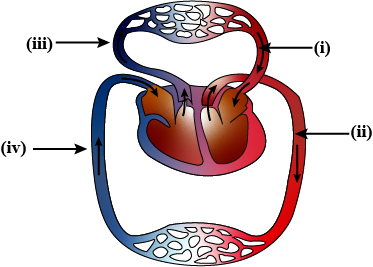
The figure given below shows a schematic plan of blood circulation in humans with labels (i) to (iv). Identify the correct label with its functions?
-
0%
(i) Pulmonary vein - takes impure blood from body part.
-
100%
(ii) Pulmonary artery - takes blood from lung to heart.
-
0%
(iii) Aorta - takes blood from heart to body parts.
-
0%
(iv) Vena cava - takes blood from body parts to the right auricle.
Q.46.
Pulmonary arteries carry ______
-
0%
Oxygenated blood to lungs
-
100%
Deoxygenated blood to heart
-
0%
Deoxygenated blood to lungs
-
0%
Oxygenated blood to heart
Q.47.
Match the columns.
| List 1 | List 2 |
| A. Regulation | 1. The removal of metabolic waste from an organism. |
| B. Reproduction | The chemical process of oxidizing organic molecules to release energy. |
| C. Respiration | The replication of an organism. |
| D. Excretion | 4. The control and coordination of chemical processes within the organism. |
-
67%
A- 3, B- 4, C- 2, D- 1
-
0%
A- 4, B- 2, C- 3, D- 1
-
33%
A- 4, B- 3, C- 2, D- 1
-
0%
A- 4, B- 3, C- 1, D- 2
Q.48.
Why does absorption of digested food occur mainly in the small intestine?
-
0%
Digestion is completed in small intestine
-
50%
Presence of villi
-
0%
Wall of intestine is richly supplied with blood vessels
-
50%
All of the above
Q.49.
Match the columns.
| List I | List II | ||
| A | Stomach | 1 | This organ secretes the chemical bile, which is used to emulsify fats. |
| B | Large intestine | 2 | This organ absorbs most of the water from the undigested food. |
| C | Small intestine | 3 | This organ is the section of the alimentary canal where most of the food is absorbed into the blood. |
| D | Liver | 4 | The structure is the site where the chemical breakdown of proteins first occurs. |
-
100%
A- 4, B- 2, C- 3, D- 1
-
0%
A- 4, B- 2, C- 1, D- 3
-
0%
A- 2, B- 4, C- 3, D- 1
-
0%
A- 4, B- 3, C- 2, D- 1
Q.50.
What will happen if platelets were absent in the blood?
-
100%
The process of clotting will be affected.
-
0%
Kwashiorkor will be the result.
-
0%
RBC will be ruptured.
-
0%
The blood will become more liquid.