Q.1.
Odometer is to mileage as compass is to
-
0%
speed
-
50%
hiking
-
0%
needle
-
50%
direction
Q.2.
Which of the following is time measuring device in modern India?
-
0%
-
0%
-
0%
-
0%
Q.3.
The odometer of a car reads $$57321.0 km$$ when the clock shows the time $$08:30$$ AM. What is the distance moved by the car, if at $$08:50 AM$$, the odometer reading has changed to $$57336.0 km$$?
-
100%
$$75\ km$$
-
0%
$$50\ km$$
-
0%
$$15\ km$$
-
0%
$$10\ km$$
Q.4.
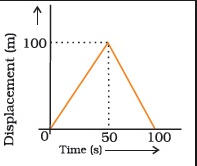
What is the distance traveled by the body during the first 100 seconds?
-
0%
200 m
-
0%
50 m
-
0%
100 m
-
0%
25 m
Q.5.
Which of the following is/are correct regarding uniform and non-uniform motion?
-
0%
For the body to be in the uniform motion, it must be moving in the straight line path
-
0%
The slope of displacement-time graph for uniform motion is constant and gives constant velocity
-
0%
A car coming to a halt is an example of non-uniform motion
-
0%
All of the above
Q.6.
Which of the following is/are good example(s) of non-uniform motion?
-
0%
When an object is moving in a circular path with uniform speed
-
0%
A car is travelling in an overcrowded zigzag road
-
0%
Motion of a pendulum
-
0%
Both B and C
Q.7.
Which of the following instrument have very high level of accuracy ?
-
100%
Electronic stopwatch
-
0%
Stop clock
-
0%
Pendulum clock
-
0%
Hour glass
Q.8.
Which is in uniform motion from the following?
-
0%
The motion of Cristiano Ronaldo in the field
-
0%
The motion of Usain Bolt in the race track
-
0%
The motion of earth around the sun
-
0%
Freely falling body
Q.9.
Which of the following distance-time graphs shows a truck moving with speed which is not constant ?
-
0%
-
0%
-
0%
-
0%
Q.10.
Which of the following is used for measuring time ?
-
0%
Fitbit
-
0%
Playstation
-
0%
Oculus Rift
-
0%
LASER
Q.11.
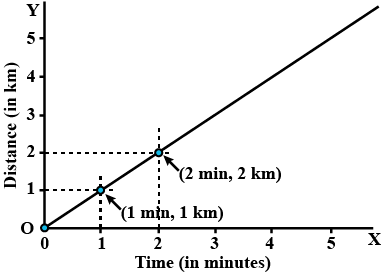
In the given distance-time graph, what is the time corresponding to $$3 \ km$$ ?
-
0%
$$1 \ min$$
-
0%
$$2 \ min$$
-
0%
$$3 \ min$$
-
0%
$$4 \ min$$
Q.12.
A scooterist covers a distance of 3 km in 5 minutes. He travels with a speed of
-
0%
$$100 m s^{-1}$$
-
0%
$$360 km h^{-1}$$
-
0%
$$100 cm s^{-1}$$
-
0%
$$600 m min^{-1}$$
Q.13.
The earliest clocks made by Egyptians in year 800 BC for measuring time was :
-
0%
sundial
-
0%
compass
-
0%
stop watch
-
0%
pendulum clock
Q.14.
$$I$$. A train runs from New Delhi to Hyderabad. It covers first distance of 240 km in 7 hrs. and nest distance of 360 km in 6 hrs.
$$II$$. Gopi takes part in a car race. He drive a distance of 70 km each in the first, second and third hours.
Which of the following statements is true.
$$II$$. Gopi takes part in a car race. He drive a distance of 70 km each in the first, second and third hours.
Which of the following statements is true.
-
0%
$$I$$, is an example uniform motion and $$II$$ is an example of non-uniform motion.
-
0%
$$I$$ is an example of non-uniform motion and $$II$$ is an example of uniform motion.
-
0%
$$I$$ and $$II$$ are examples of uniform motion.
-
0%
$$I$$ and $$II$$ are example of non-uniform motion.
Q.15.
Match the columns and select the correct option from the codes given below.
a b c d e
| Column-I | Column-II | ||
| (a) | Days | (i) | Second |
| (b) | Months | (ii) | m/s |
| (c) | Time | (iii) | Metre |
| (d) | Speed | (iv) | The time from one sunrise to the next |
| (e) | Distance | (v) | One new moon to the next. |
-
0%
(v) (i) (ii) (iii) (iv)
-
0%
(iv) (v) (i) (ii) (iii)
-
0%
(ii) (iii) (iv) (v) (i)
-
0%
(i) (ii) (iii) (iv)
Q.16.
$$150\ m$$ long train takes $$10\ s$$ to pass a man who is going in the same direction at the speed of $$2\ kmph$$. What is the speed of the train?
-
0%
$$52\ kmph$$
-
0%
$$56\ kmph$$
-
0%
$$84\ kmph$$
-
0%
Data inadequate
Q.17.
Which of the following is not a unit of speed?
-
0%
Meter/second
-
0%
Second/meter
-
0%
Kilometer/hour
-
0%
Meter/minute.
Q.18.
Speedometer of a car measures
-
0%
average speed
-
0%
average velocity
-
0%
instantaneous speed
-
0%
instantaneous velocity
Q.19.
In order to measure very short intervals, we mostly use :
-
0%
stop clocks
-
0%
stop watches
-
0%
wall clocks
-
0%
A and B
Q.20.
What determine the nature of the path followed by the particle
-
0%
Speed
-
0%
Velocity
-
0%
Acceleration
-
0%
None
Q.21.
A scooterist travels at 30 km/h along straight path for 20 min. What is distance?
-
0%
1.5 km
-
0%
6 km
-
0%
10 km
-
0%
90 km
Q.22.
Speedometer measures the speed of the car in
-
0%
m $$s^{-1}$$
-
0%
km $$h^{-1}$$
-
0%
cm $$s^{-1}$$
-
0%
km $$min^{-1}$$
Q.23.
A car covers a distance of $$2 \ km$$ in $$2.5$$ minutes. If it covers half of the distance with speed $$40 \ km/hr$$, the rest distance it shall cover with a speed of:
-
0%
$$56 \ km/hr$$
-
0%
$$60 \ km/hr$$
-
0%
$$48 \ km/hr$$
-
0%
$$50 \ km/hr$$
Q.24.
Which of the following physical quantities has same unit in all the three system of units?
-
0%
Mass
-
0%
Length
-
0%
Time
-
0%
None of these
Q.25.
Rajdhini express moves at a speed of $$150\ km/h$$. How long will it take to cover a distance of $$15\ km$$?
-
0%
$$0.1\ h$$
-
0%
$$1.125\ h$$
-
0%
$$2.125\ h$$
-
0%
$$3.125\ h$$
Q.26.
A $$350\,m$$ long train passes over a $$250\,m$$ long bridge at a speed of $$54\,km/h$$. How long will it takes to cross the bridge?
-
0%
$$40\,minutes$$
-
0%
$$2/3\,minutes$$
-
0%
$$2/3\,hr$$
-
0%
$$1/90 s$$
Q.27.
If we denote speed by $$S$$, distance by $$D$$ and time by $$T$$ the relationship these equation is?
-
0%
$$S= D \times T $$
-
0%
$$T= \frac {S}{D}$$
-
0%
$$S = \frac {1}{T} \times D$$
-
0%
$$ S= \frac {T}{D}$$
Q.28.
Which one of the following can not be used for measurement of time ?
-
0%
A leaking tap
-
0%
Single pendulum
-
0%
Shadow of an object during the day
-
0%
Blinking of eyes
Q.29.
Which of the following time measuring device is most precise?
-
0%
A wall clock
-
0%
A stop watch
-
0%
A digital watch
-
0%
An atomic clock
Q.30.
A bus travels 54 km in 90 minutes. The speed of the bus is?
-
0%
0.6m/s
-
0%
10m/s
-
0%
5.4m/s
-
0%
3.6 m/s